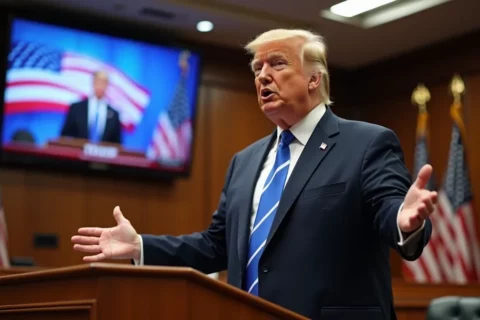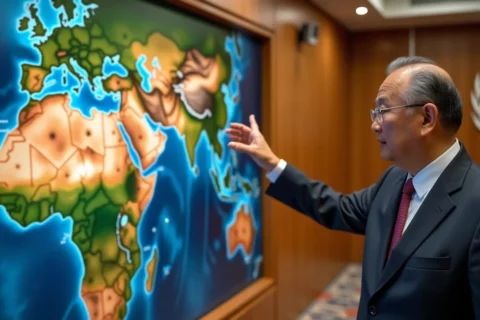
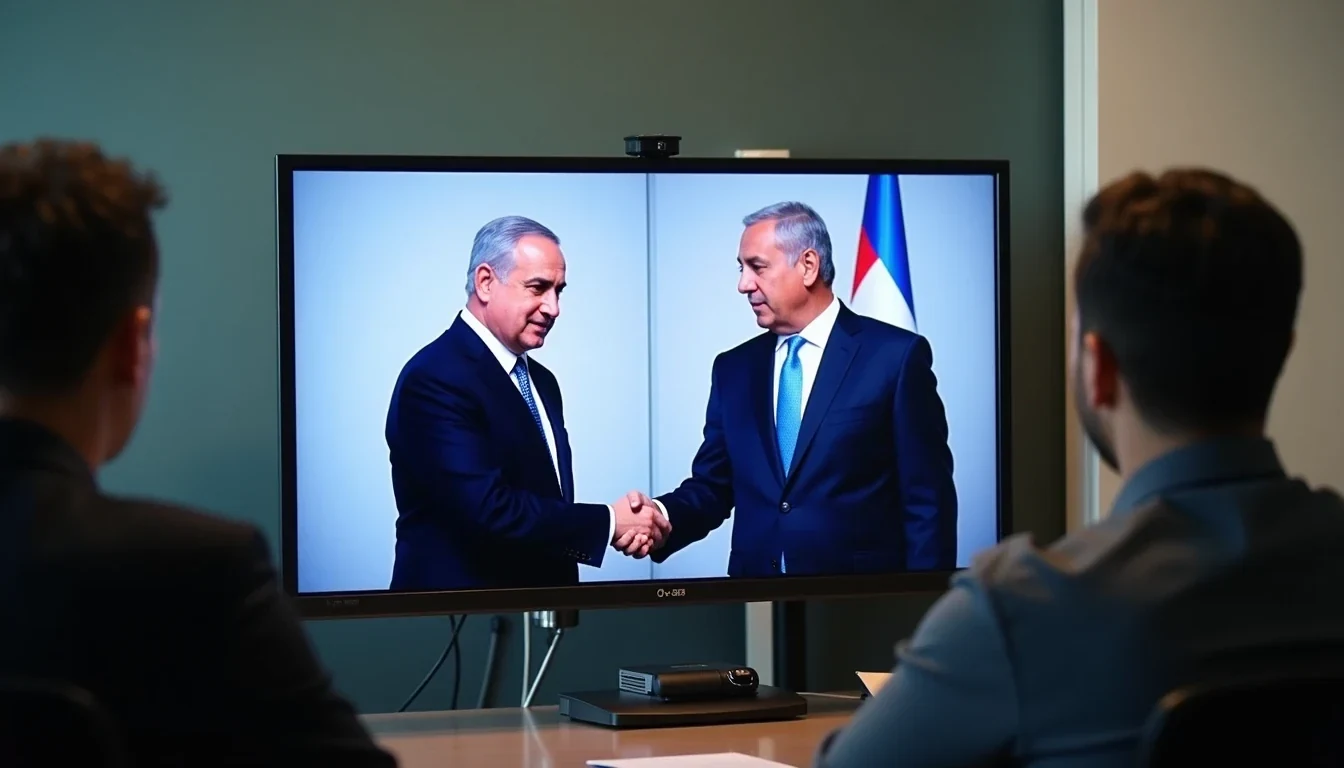
Two men spoke past each other last week, and in the gap between their words you can hear the Middle East cracking open. Benjamin Netanyahu stood before cameras and described Israel as the region’s anchor, a military power so thoroughly dominant that its neighbors must either adapt or remain isolated. Hours later, Abbas Araghchi responded in kind, refusing even the word “Israel” and calling it instead an American outpost planted in Islamic territory, a state whose very existence constitutes occupation. Neither man was making news. Both were stating first principles, and that makes the exchange worth watching. When adversaries stop negotiating and start reciting catechisms, the ground beneath them has already shifted.
What Each Side Is Actually Claiming
Netanyahu’s framing rests on a single bet: that military superiority can be converted into political order. He speaks of Israel’s qualitative military edge as both shield and invitation, a deterrent against attack and a signal to Arab capitals that alignment with Jerusalem carries more upside than solidarity with Tehran. The Abraham Accords, brokered by Washington in 2020, represent the payoff. The UAE, Bahrain, Sudan, and Morocco normalized relations because they calculated that Iran’s regional project posed the greater threat, not because they grew fond of Israeli policy. Netanyahu treats this as vindication. Israel, in his telling, has become unavoidable.
Araghchi’s rebuttal is equally systematic and far more absolute. Iranian officials deny the legitimacy of the state itself. The terminology is deliberate. “Zionist entity” and “Zionist regime” function as performative erasure, a way of speaking that refuses the premise of the conversation Netanyahu wants to have. Behind this rhetoric sits a strategic claim: Israel functions as an extension of American power, not an independent actor. The $3.8 billion in annual U.S. military aid, the F-35 sales, the diplomatic cover at the United Nations are not evidence of alliance in Tehran’s reading but proof of subordination. Araghchi’s argument, taken seriously, means there is nothing to negotiate with Jerusalem because Jerusalem is not the address.
Both claims leave something out, and the omissions are telling. Netanyahu’s account of regional integration glosses over the Palestinian issue, which remains the raw nerve that the Accords did not touch. No Arab government has abandoned the rhetorical commitment to Palestinian statehood, and several of the Accords signatories have seen domestic backlash that constrains how far they can publicly align with Israel. Araghchi, for his part, treats Iran’s proxy network as organic resistance rather than foreign policy by other means. Hezbollah’s 150,000 rockets in Lebanon, the weapons transfers through Syria, the support for Hamas and Palestinian Islamic Jihad in Gaza are presented as popular will when they are in fact cultivated, funded, and directed from Tehran.
The American Shadow
Washington’s role in this confrontation is structural. The 2016 Memorandum of Understanding guaranteeing $3.8 billion annually in military assistance to Israel through 2028 is only the most visible commitment. Less visible but equally consequential is the intelligence sharing, the joint military exercises, and the implicit promise that serious threats to Israeli survival will trigger American involvement. This arrangement gives Netanyahu the confidence to act unilaterally, to strike Iranian assets in Syria hundreds of times without seeking prior approval, to treat Israel’s security perimeter as extending well beyond its borders.
For Iran, this same American presence is the original sin that justifies nearly everything that follows. The U.S. Fifth Fleet headquartered in Bahrain, CENTCOM’s airbases and naval assets, the sanctions regime that has crippled Iranian oil exports and locked the country out of international financial markets are not defensive postures in Tehran’s view but encirclement. The 2018 withdrawal from the Joint Comprehensive Plan of Action, the nuclear deal negotiated under Obama, confirmed what Iranian hardliners had always suspected: American diplomacy is a prelude to American pressure, and the only reliable deterrent is military capacity the U.S. cannot easily destroy.
The result is a peculiar symmetry of dependence. Israel’s freedom of action is tethered to American tolerance and American electoral cycles. Iran’s resistance posture is equally tethered to American hostility, which the regime uses to justify economic mismanagement and political repression at home. Neither side can fully escape the other, and neither can escape Washington’s gravitational pull.
The Military Math and Its Limits
The balance of forces is not in serious dispute. Israel spends roughly $24.4 billion on defense annually and maintains the region’s most technologically advanced military, including missile defense systems that have proven effective against rocket barrages. Iran’s defense budget is comparable in nominal terms, around $24.6 billion, but much of that flows through the Islamic Revolutionary Guard Corps and its Quds Force, which specializes in proxy cultivation and asymmetric warfare rather than conventional confrontation.
Iran’s compensation is volume and reach. Its ballistic missile program is the largest and most diverse in the Middle East, capable of striking targets across the region. Its proxy in Lebanon, Hezbollah, possesses enough rockets and missiles to overwhelm Israeli defenses in a saturation attack. The Houthis in Yemen have demonstrated the ability to threaten shipping in the Red Sea. Iranian-backed militias in Iraq and Syria can harass American forces and constrain Israeli operations.
This is not a recipe for Iranian victory in any conventional sense. It is a recipe for mutual vulnerability. Israel cannot eliminate Iran’s proxy network without catastrophic escalation. Iran cannot challenge Israel directly without risking annihilation. The standoff persists because both sides have sufficient capacity to punish the other severely, and neither has sufficient capacity to disarm the other decisively.
Where This Actually Goes
The region is not moving toward diplomacy. That much is clear from the rhetoric itself. When leaders describe the basic political arrangements of the Middle East in mutually exclusive terms, when one claims dominance and the other denies legitimacy, the space for compromise has already collapsed. What remains is management of the confrontation, not resolution.
The practical alternatives are grimly familiar. Further entrenchment means more proxy conflict in Syria, Lebanon, Gaza, and potentially Yemen. It means continued Israeli airstrikes against Iranian weapons transfers. It means Iranian enrichment of uranium to near-weapons-grade levels, not because Tehran has decided to build a bomb but because nuclear latency offers insurance against the military option Israel keeps on the table. It means the Strait of Hormuz remains a chokepoint where 20% of global oil supply passes through waters that could be closed in hours.
The less discussed possibility is that both regimes benefit from the confrontation more than they admit. Netanyahu faces domestic pressures, including the ongoing legal proceedings against him and the instability of his coalition; an external threat helps consolidate his position. The Iranian leadership, struggling with economic dysfunction and periodic popular protest, uses American and Israeli hostility to frame dissent as treason. The enemy across the border is also, conveniently, the enemy within.
What Washington can do is limited and getting more so. The Biden administration has tried to thread a needle, maintaining support for Israel while attempting to revive some form of nuclear constraint on Iran. The result satisfies nobody. Israeli officials distrust any diplomacy that does not address Iran’s regional behavior. Iranian officials distrust any American commitment that could be reversed by the next election. Both are rational in their distrust.
The exchange between Netanyahu and Araghchi was not a dialogue. It was a dual assertion of irreconcilable worldviews, performed for domestic audiences and for Washington, the external power that both need and both resent. The Middle East they describe cannot be shared. The question is whether it can be partitioned, or whether the partition itself is merely a prelude to wider war.