Iran has spent four decades building a reputation for strategic patience, the kind that waits years to settle scores. The message delivered through an Iranian intelligence source this month inverts that doctrine into something more theatrical and more cruel. It promises not swift revenge, but prolonged spectacle. Donald Trump, according to this source, lives only because his enemies prefer him to witness the destruction of everything he has built, including his family, before they finish him. The target named explicitly is Barron Trump, the former president’s youngest son, a college student with no policy portfolio and no official role in his father’s political operation.
This is not how state-level antagonism typically operates. Even at the lowest points of US-Iran hostility, including the 2020 drone strike that killed Qassem Soleimani, the violence remained bounded by a recognizable framework: military officials targeting military officials, state assets striking state assets. The threat against Barron Trump abandons that framework entirely. It substitutes psychological warfare for kinetic action, personal suffering for strategic gain, and the vulnerability of a civilian family member for the hardened infrastructure of state power.
What Tehran Is Communicating
The language of the threat deserves examination on its own terms because it reveals how Iran wants to be read. The intelligence source framed the operation as “justice” rather than assassination, emphasizing its deliberateness with the phrase “slow, but always on time.” The explicit wish for Trump to see Barron killed, and all descendants eliminated, before his own death represents a calculated inversion of the usual logic of political violence, which typically seeks to remove a target quickly and deny them response time.
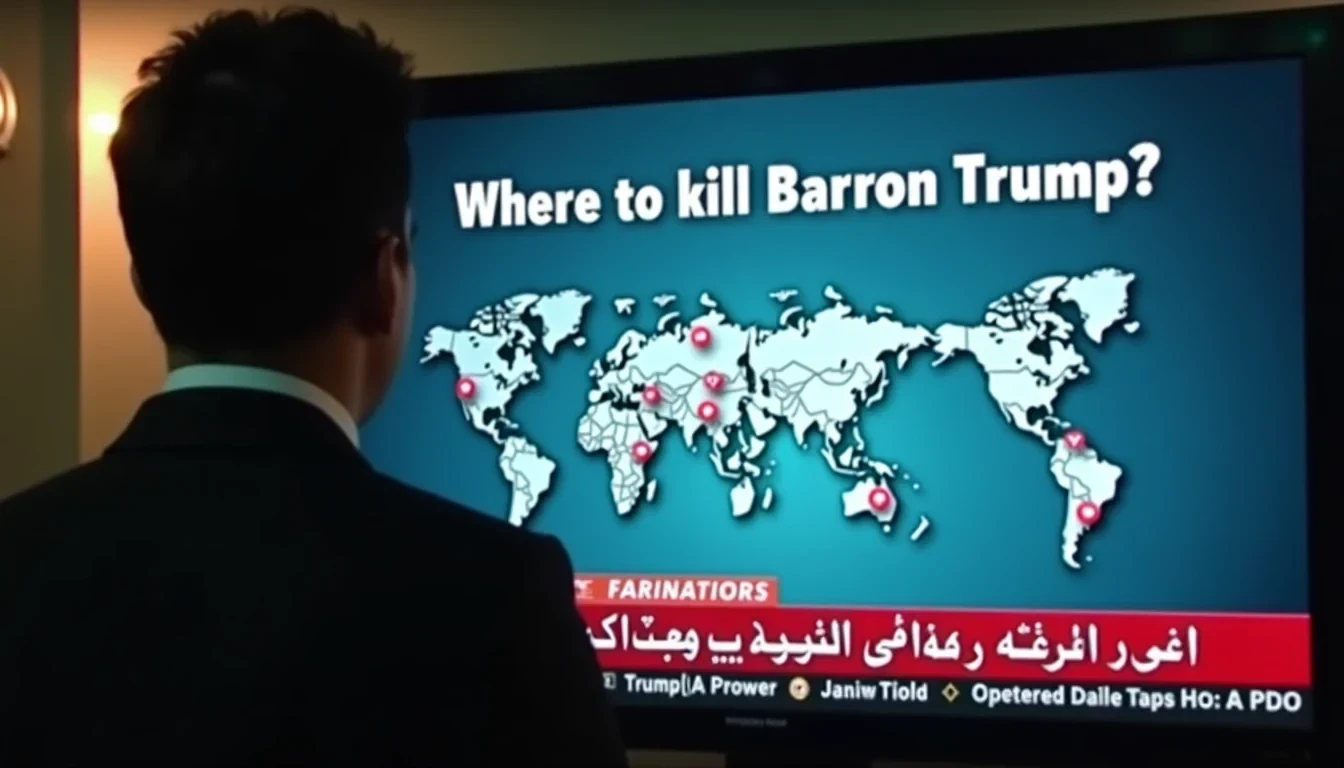
Iranian state television amplified this messaging in August 2026 with a nearly three-minute video that displayed an English-language graphic asking “Where to kill Barron Trump?!” The broadcast alleged ongoing surveillance, referenced a potential $10 million bounty, and showed graphics of locations including Trump Tower in New York. The video functioned as both threat and performance, designed for consumption in the American media environment rather than merely for domestic Iranian audiences.
The demonstration of intelligence penetration mattered as much as the verbal threat itself. Iranian sources reportedly showed knowledge of Barron Trump’s university location and daily movements, a display of reach intended to prove that distance and security protocols provide no guarantee of safety. The reported result, that Barron has been moved to a bunker and is experiencing panic attacks, suggests the psychological operation is achieving at least part of its intended effect regardless of whether the physical threat materializes.
The US Response and Its Limits
The American response has operated on three tracks simultaneously, each revealing different constraints and calculations. The Secret Service confirmed awareness of the state television video and stated that all threats are investigated, but declined operational specifics. This is standard protocol, though the standard itself becomes strained when the threat involves demonstrated knowledge of a protectee’s location.
The economic track came through Treasury Secretary Scott Bessent, who announced aggressive sanctions targeting Iranian digital assets, gold reserves, and oil exports. These measures extend existing pressure but do not represent a novel response. The Treasury has deployed similar tools against Iran for years with limited effect on its regional behavior or its willingness to conduct asymmetric operations.
The military track escalated more sharply. The US Navy and Space Force established a blockade of Iranian ports, while the USS George Washington was deployed to the Strait of Hormuz. Trump issued a specific warning that any vessel deploying new naval mines “will be destroyed,” and has previously stated that any Iranian assassination attempt would result in the “decimation” and “destruction” of Iran itself. The former president has also modified his personal travel security, including secretly switching aircraft to evade tracking.
This three-track response reveals the fundamental problem the US faces. Economic sanctions and military deterrence are designed for state actors making rational calculations about national interest. They are poorly calibrated to address threats whose primary purpose is psychological impact, whose author may value demonstration over outcome, and whose success is measured in fear generated rather than objectives achieved.
The Erosion of an Unwritten Rule
International conflict has always maintained certain unwritten boundaries, lines that were crossed only at cost to the crosser’s legitimacy. The targeting of non-combatant family members, particularly those without political role or policy involvement, ranked among the most widely observed. This was not humanitarianism; it was pragmatism. Leaders who expected their children to be held harmless had reduced incentive to escalate to absolute measures, and states that observed the boundary preserved options for de-escalation that would otherwise close.
The threat against Barron Trump, and the apparent Iranian willingness to broadcast it through official channels, suggests this boundary is eroding. The erosion is not unique to Iran. The US itself has conducted operations targeting family members of terrorist leaders, and the Trump administration’s killing of Soleimani represented its own expansion of acceptable targets. But the explicit, prolonged, and personally detailed nature of the current threat represents a different category of boundary-crossing, one that weaponizes the emotional infrastructure of family itself.
The strategic implications extend beyond this specific conflict. If personal vulnerability becomes a standard tool of statecraft, the security requirements for political figures expand dramatically, the pool of willing participants in political life contracts predictably, and the domestic political effects of foreign threats become harder to calculate. A population that sees a leader’s child targeted may rally around that leader, or may question whether the costs of leadership have become unacceptable. The uncertainty itself becomes a tool for adversaries who understand American political dynamics well enough to exploit them.
What Survives the Frame
Iran’s framing of this operation as “justice” for the Soleimani strike does not survive analytical scrutiny intact. The 2020 killing was a military action against a military commander actively directing operations against US interests. Barron Trump is a civilian student. The attempt to equate these categories requires either a theory of collective familial guilt that no modern state officially endorses, or a candid admission that the targeting serves psychological rather than retributive purposes.
Trump’s framing of the situation as requiring potential “decimation” also merits examination. The former president’s rhetorical tendency toward maximal threats has been consistent across his political career, but the specific context here, a threat against his own son, removes some of the usual distance between political performance and personal response. The question is whether the response he advocates, military destruction of Iran, would actually prevent similar future threats or would instead validate the Iranian narrative of inevitable conflict while potentially generating the very martyrdom dynamics that prolonged suffering was designed to avoid.
The most accurate framing may be the bleakest: this incident reveals a form of conflict for which existing deterrent structures are poorly designed, and for which no obvious alternative has emerged. The US cannot effectively threaten to destroy Iran more thoroughly than it has already threatened. Iran cannot achieve the physical elimination of a former president’s family without triggering consequences it likely does not genuinely seek. Both sides are left performing intensity for audiences domestic and foreign, while the actual vulnerability, that of a college student moved to a bunker, remains unresolved by any of the grand gestures surrounding it.