A religious sect with roughly 200 to 500 members has spent sixteen years treating international borders as speed bumps. Lev Tahor, founded in Israel in 1988 by Rabbi Shlomo Helbrans, has relocated its entire community across six countries since 2008, always departing just as child welfare investigations intensified. The pattern is the organization’s operational signature, and it is now depositing members on American soil faster than US authorities can assemble cases against them.
The group’s most recent movements expose a structural weakness Lev Tahor has learned to exploit. In late 2024, Guatemalan authorities raided a compound and placed 160 minors and 40 women into protective custody, citing active human trafficking and abuse investigations. Members responded by attempting to break into the care center to reclaim the children. Colombia expelled several members directly to the United States, determining their presence posed unacceptable risks to children’s rights. American border agents received them because no outstanding US warrant justified refusal of entry. This loophole the sect has refined into an art form.
What Lev Tahor Actually Practices
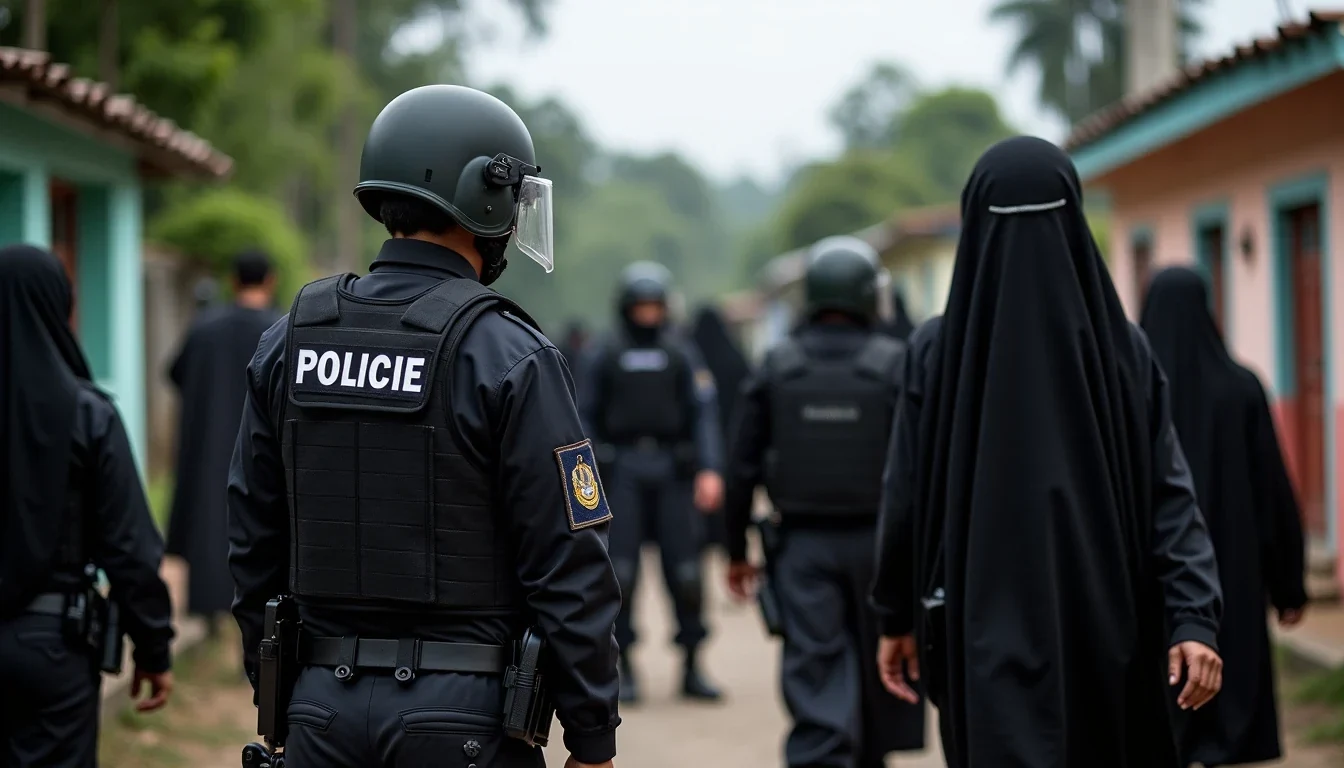
The characterization of Lev Tahor as a cult rests on specific mechanisms of control, not theological eccentricity alone. Girls must wear head-to-toe black robes called “shalim” from age three, covering everything except the face. Daily life centers on prayer sessions that consume many hours. Members follow a restrictive diet that has reportedly left children malnourished. Teenage marriage is encouraged, with some unions involving girls as young as thirteen or fourteen. Absolute obedience to the Helbrans family is mandatory, and deviation brings severe social punishment or physical discipline.
The group’s anti-Zionism operates on messianic grounds, not political ones. Lev Tahor holds that human establishment of a Jewish state constitutes sacrilege, that redemption arrives only with the Messiah, and that the State of Israel is therefore illegitimate. This is not abstract theology for internal discussion. Members previously attempted to seek refuge in Iran, selecting a hostile nation because of its opposition to Israel. When secular authorities intervene, leaders routinely frame the intervention as religious persecution rooted in this ideological conflict.
The Evasion Playbook
Lev Tahor’s relocations follow a recognizable rhythm. The group established its first base outside Israel in Sainte-Agathe-des-Monts, Quebec, during the early 2000s. When Quebec’s child welfare agencies opened investigations in 2013, approximately 200 members fled overnight to Chatham-Kent, Ontario. As Ontario scrutiny intensified, the community fragmented and dispersed across Guatemala, Mexico, Colombia, and the United States, often traveling in smaller groups that attracted less attention.
Guatemala became the primary hub for several years, with members settling in remote villages where state presence was minimal. The late 2024 raid disrupted this arrangement but did not destroy the network. The attempted break-in at the care center demonstrated organizational cohesion and a willingness to use force against state child protection measures. The Colombian expulsion created a new problem for US agencies: members arriving without criminal convictions that would trigger automatic detention, yet carrying documented histories of child welfare evasion across multiple jurisdictions.
The 2018 federal conviction of two members in New York illustrates the operational methods. The pair kidnapped two children from protective custody and transported them to Mexico, demonstrating the sect’s priority on reclaiming children from state care and its comfort with cross-border criminal activity to achieve that goal.
Why US Law Struggles to Respond
American authorities face three interconnected barriers when Lev Tahor members appear at ports of entry. First, the absence of a unified international child protection registry means that protective custody orders issued in Guatemala or Quebec do not automatically register in US systems. A child removed from parental custody in Antigua Guatemala can arrive in the United States with no visible flag in immigration databases.
Second, evidence standards vary dramatically across the jurisdictions Lev Tahor has occupied. Testimony gathered under Guatemalan procedural rules may not meet federal admissibility requirements. Physical evidence from a 2013 Quebec investigation sits in Canadian archives, requiring formal mutual legal assistance treaty requests that move at diplomatic speed while the sect relocates again.
Third, the group’s legal defenses deliberately complicate intervention. Members invoke asylum claims based on alleged religious persecution. They cite free exercise protections under the First Amendment. They challenge the definition of abuse by pointing to varying ages of consent across North and Central America. Each argument forces US courts to parse constitutional and immigration questions that consume months or years, during which children remain in the community.
The resource allocation problem is equally severe. Tracking a fragmented, secretive group across multiple countries requires sustained coordination between Homeland Security, State Department diplomatic channels, FBI legal attachés, and foreign counterparts with their own institutional constraints. Lev Tahor operates with the cohesion of a single organization; the governments attempting to monitor it do not.
The Incentive Structure That Preserves the Pattern
Lev Tahor has correctly identified that democratic legal systems move slowly and that child protection cases carry evidentiary burdens that cross-border relocation can disrupt. Each successful relocation reinforces the strategy. Each gap between investigation and enforcement teaches the leadership which jurisdictions coordinate poorly and which borders remain porous.
The Colombian expulsion to the United States represents a particular failure mode. Colombian authorities determined the risk to children was sufficient to justify removal from their territory, yet lacked a mechanism to transfer that determination into American legal action. The members arrived as deportees rather than fugitives, triggering immigration processing rather than criminal investigation. US child welfare agencies in the receiving jurisdiction may not learn of the arrival until after placement has occurred.
The sect’s anti-Zionist narrative serves a functional purpose in this system. By framing all state intervention as religious persecution motivated by hostility to their theological position, Lev Tahor attempts to shift the public and legal conversation from specific allegations of child abuse to abstract questions of religious freedom. The strategy has not prevented investigations, but it has complicated them, adding layers of constitutional and diplomatic review that consume time the group uses to plan its next move.
What Remains Unresolved
The fundamental challenge for US authorities is not identifying Lev Tahor’s practices or locating its members. The challenge is constructing legal interventions that operate faster than the organization’s relocation cycle. Current frameworks assume that child protection cases proceed within stable jurisdictions, that evidence accumulates in single court systems, and that protective custody orders retain force across administrative boundaries. None of these assumptions hold when a group has systematically optimized itself to defeat them.
The 160 minors removed in Guatemala remain in state care, their futures uncertain. The members expelled from Colombia are now present in the United States, their legal status and locations not publicly disclosed. The leadership structure that directed sixteen years of international evasion remains largely intact. Until American federal and state agencies develop protocols specifically designed for transnational child protection evasion, Lev Tahor will continue treating US borders not as barriers but as transitions between enforcement gaps.