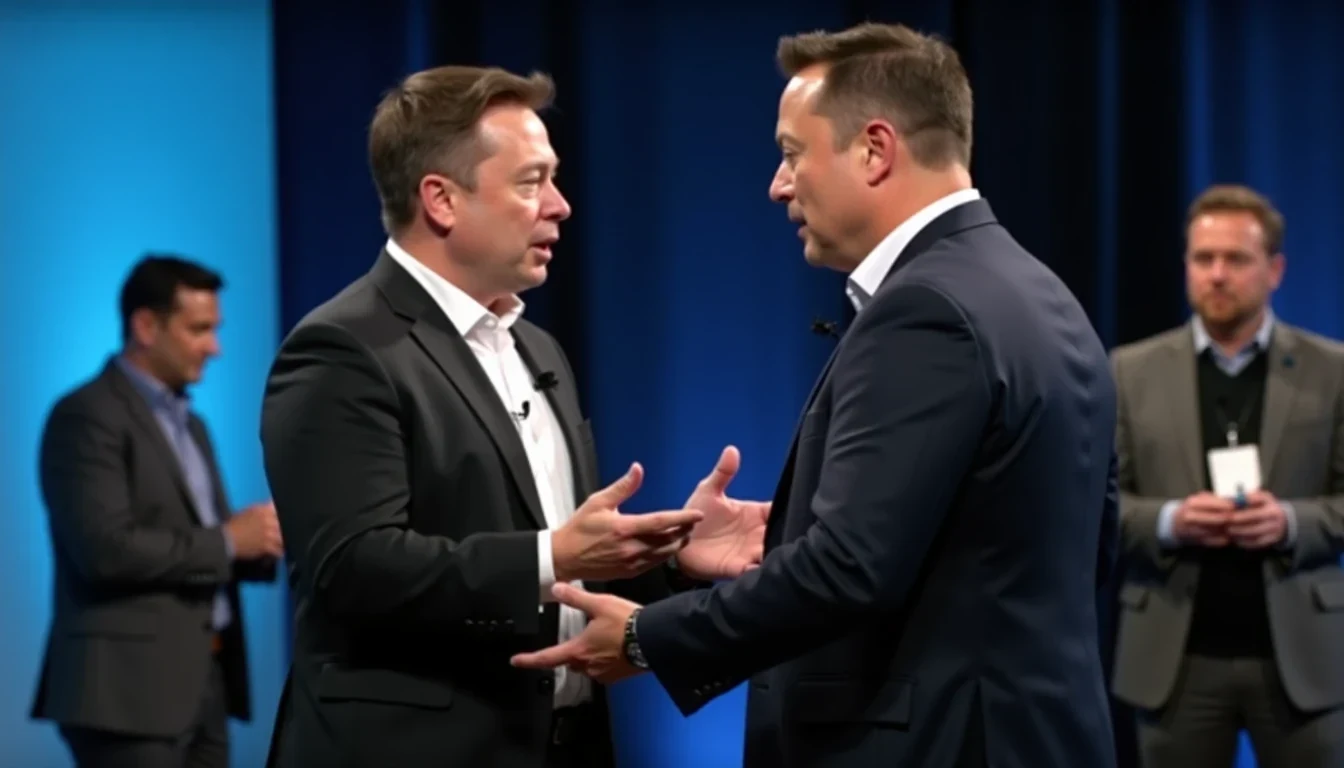
Kevin O’Leary’s story about Elon Musk walking out of conversations that stop holding his interest says more about media habits than it does about Musk’s manners. The anecdote is small, almost comic. The reaction to it is the real subject. Some hear ruthless focus and elite time management. Others hear contempt, vanity, and the usual billionaire allergy to ordinary social rules.
That split is not accidental. Musk has become a ready-made political character. His personal quirks get sorted into prewritten roles as soon as they enter the bloodstream of U.S. commentary. The same gesture can be sold as disciplined efficiency or as proof that the man has no patience for anyone who cannot serve his purpose. Media outlets depend on that framing.
The Same Habit, Two Stories
O’Leary’s account casts Musk as a person who treats attention like capital. If a conversation is not useful, interesting, or tied to a problem he wants solved, he reportedly leaves. O’Leary’s point was plain: that kind of behavior fits a founder who is obsessively protective of his time and mental energy. In that reading, Musk’s habit is part of the same operating system that helped build Tesla and SpaceX into industrial giants.
That version of the story flatters the pro-business imagination. It turns impatience into discipline, and social awkwardness into elite efficiency. The underlying claim is simple enough: if your time is absurdly valuable, then wasting it on dead-end conversations is irrational. From that angle, “walking away” looks less like a breach of etiquette than a refusal to pretend that every exchange deserves equal status.
The opposing version is just as tidy. Musk leaves because he can. He ignores people because he assumes his own priorities outrank theirs. In that telling, the behavior is not a productivity hack. It is a billionaire’s habit of deciding, in real time, whose voice matters. Progressives and many mainstream critics are not wrong to see the arrogance in that. Power changes the social cost of discourtesy. When a billionaire cuts short a conversation, the act gets repackaged as force of personality.
Why The Media Loves A Split Screen
Musk is a dream subject for the modern media economy. Almost nothing he does stays inside the lane of business. He buys a major platform, picks fights in public, and drags corporate power into political argument. His personality is never just personality. It becomes evidence in a broader case about free speech, labor, elite power, and the culture wars.
Conservative and libertarian outlets often present Musk as the rare rich man willing to offend the right people. They lean into the image of a disruptor who will not bend to consensus. His quirks become proof that he is thinking independently. His bluntness becomes authenticity. His refusal to sit through nonsense becomes a kind of founder’s virtue, the sort of trait that supposedly separates builders from bureaucrats.
Progressive outlets usually build the opposite frame. Musk becomes the erratic plutocrat, a man whose wealth insulates him from ordinary consequences and whose public behavior confirms it. In that frame, the same “walk away” habit is folded into a larger story about disdain, labor conflict, misinformation, and the dangers of giving one man that much control over infrastructure, conversation, and attention. The habit is used as shorthand for an entire class of behavior.
Centrist business coverage often lands in the middle, though not always in a neutral way. It will praise the results and question the management style in the same breath. That can sound balanced, but it still follows the same logic of simplification. Musk is turned into a single-use symbol. Either he is the indispensable builder or the unstable liability. The rest gets trimmed away.
The Incentive Is The Story
The reason this works is not hard to find. Musk generates traffic. He generates arguments. He generates easy headlines because every detail about him can be made to serve an existing narrative. Media outlets do not have to invent drama when he supplies it. They just choose which part of him to emphasize.
That choice is shaped by audience loyalty and ideological sorting. A publication knows roughly what its readers already suspect about Musk. So the incentive is to confirm the suspicion, not complicate it. The pro-Musk audience wants proof that he is being attacked by people who do not understand builders. The anti-Musk audience wants proof that he is exactly the kind of arrogant billionaire they feared. Nuance is expensive. Certainty sells.
O’Leary’s anecdote exposes the machinery because it is so minor. Nobody needs a grand theory of civilization to explain a man leaving a boring conversation. Yet even that small act gets inflated into an emblem. In one media universe, it is ruthless time allocation. In another, it is contempt made visible. The facts do not change. The framing does.
What The Archetype Does To Politics
Musk’s public persona now sits at the edge of business, media, and U.S. political conflict, especially since his acquisition of Twitter, now X. That overlap matters. It makes him more than a CEO. He becomes a political archetype, a proxy onto which larger arguments about technology, speech, and elite power get projected.
The danger is that archetypes flatten judgment. If Musk is always the genius founder, then any criticism looks like envy or ideology. If he is always the reckless plutocrat, then any success becomes evidence that the system rewards bad actors. Both stories are convenient. Both are incomplete. Both encourage audiences to sort reality into character types instead of asking sharper questions about power.
O’Leary probably meant his anecdote as a compliment. Fair enough. Musk’s ability to ignore noise may well be part of what makes him effective in environments where most people drift, posture, and stall. But media coverage rarely leaves it there. The trait becomes a test case for whatever story an outlet already wants to tell about wealth, competence, and authority.
That is the real lesson. Public figures are manufactured into symbols by outlets that have their own incentives. Musk is one of the most useful symbols in circulation. The walk-away habit is trivial on its face. The argument around it is not.