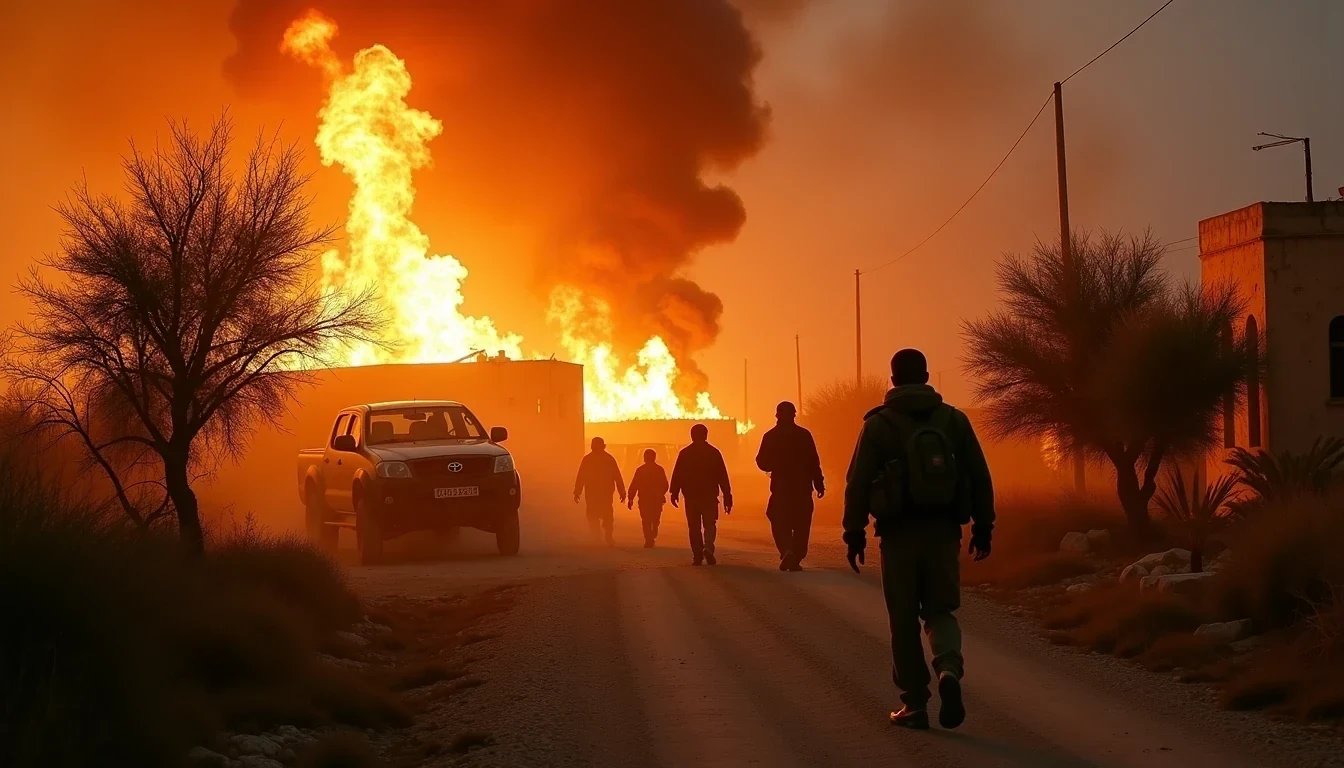
The West Bank is being treated like a map that can be redrawn with fire, roadblocks, and a body count. Armed settlers move into villages, homes burn, olive groves go up in smoke, and Palestinian families leave. The same logic drives all three events: if the land becomes too dangerous to live on, it can be taken without a formal declaration.
Four Palestinians killed in the recent wave of attacks is not an accident. It is pressure. More than 1,000 settler attacks this year, at a record pace, point to something more deliberate than chaos or revenge. The pattern looks like territorial consolidation disguised as security.
The story settlers tell
The public justification is simple enough to fit on a bumper sticker. Israeli officials and settler groups present the violence as defense, a response to threat, a local eruption in a hostile environment. In that version, the settlers are protecting Jewish lives in a place where violence supposedly came first; they are not seizing anything.
That framing collapses under the details. The attacks are not evenly spread, random, or self-limiting. They repeatedly hit Palestinian villages, farmland, water infrastructure, and herding communities in areas where outposts can expand. Olive trees are especially revealing. They are not just symbolic targets. They are income, family inheritance, and permanence. When more than 10,000 olive trees were reported damaged or destroyed in 2023, the point was to break the economic base that lets Palestinians remain rooted on the land, not just punishment.
Huwara in February 2023 showed the logic in public. Hundreds of settlers stormed the town, torching houses and cars. Turmus Ayya faced a similar assault in June 2023 after a shooting elsewhere. These were not isolated acts of rage by individuals acting alone. They looked organized, collective, and punitive, with entire communities made to absorb the message that the border between state power and settler militancy is thinner than official statements admit.
The pattern on the ground
The geography matters. Area C, which makes up more than 60 percent of the West Bank, contains much of the open land, agricultural ground, and water access that any viable Palestinian state would need. It is also where settlement growth is easiest to advance by degrees. A new outpost appears, a road follows, Palestinian access narrows, and more land is declared off limits. Then the language changes from expansion to administration, as if the facts on the ground arrived by weather.
That is the practical objective: not a flag planted on a hilltop for the evening news, but a slow conversion of Palestinian space into Israeli-controlled continuity. Outposts, roads, and violent intimidation work together. One family leaves, then another. A herding community that depended on access to nearby pasture loses its animals, its water, or both. At least 16 Palestinian herding communities, more than 1,000 people, have been displaced since October 7, 2023 under this combination of attacks and restrictions.
The political sponsors are not mysterious either. Bezalel Smotrich, who holds authority over civilian affairs in the West Bank, has pushed settlement expansion and treated Palestinian statehood as something to be blocked, not negotiated. Itamar Ben-Gvir has built his own politics around maximalist control and permanent Jewish sovereignty. The settler movement, including organizations such as the Yesha Council, wants the same end state in more polished language: a West Bank so fragmented that Palestinian sovereignty becomes a slogan rather than a territory.
The violence keeps pointing in one direction. A campaign to make Palestinian life unbearable is also a campaign to lower the cost of annexation without officially announcing annexation. The land is the goal. The fear is the method.
Military cover makes it work
The Israeli military’s role strains the official story. On paper, the IDF is supposed to secure all residents and prevent unauthorized violence. In practice, human rights groups have documented soldiers watching attacks unfold, delaying intervention, or acting in ways that shield settlers rather than restrain them. B’Tselem and Yesh Din have both described this gap between policy and behavior for years.
That gap matters because the military is not just a bystander in a country where civilians and soldiers live near each other. Its presence gives the settler project operational cover. When soldiers stand near an attack site and Palestinians are the ones who end up confined, searched, or restricted after the damage is done, the state is helping sort the political winners from the losers; it is not simply failing to stop private violence.
The law also moves in the same direction. The 2017 Regularization Law tried to retrofit legality onto thousands of settler homes built on privately owned Palestinian land. The Israeli Supreme Court later struck it down, but the effort itself showed the destination clearly enough. The aim was to rewrite legal boundaries after the fact, not to respect them.
This is how a land grab works when it wants to keep the language of legitimacy. Call the outpost illegal until it has enough residents. Call the violence a security response until the victims leave. Call the movement restriction a precaution after the attack. Each label lowers the political cost of the next step.
War elsewhere gives the West Bank room to burn
The Gaza war has done more than absorb attention. It has reduced scrutiny. Since October 7, 2023, the West Bank has been able to slide deeper into a routine of attacks with less sustained pressure from Washington, less media focus, and less diplomatic urgency than would otherwise exist. UN OCHA reported that settler attacks rose sharply after October 7, from roughly three incidents a day in the preceding nine months to about six per day afterward.
That doubling is not a side effect. It is the opening. When the region is preoccupied, when everyone is arguing about the larger war, local violence can advance under a different label. Self-defense becomes the word used to cover expansion. Emergency becomes the word used to excuse dispossession.
The strategic logic is plain. If the West Bank is carved into disconnected Palestinian islands, if villages are emptied by intimidation, if outposts harden into permanent settlements, then the possibility of a two-state settlement is not merely weakened. It is administratively strangled. The line between temporary unrest and permanent control has already been crossed.