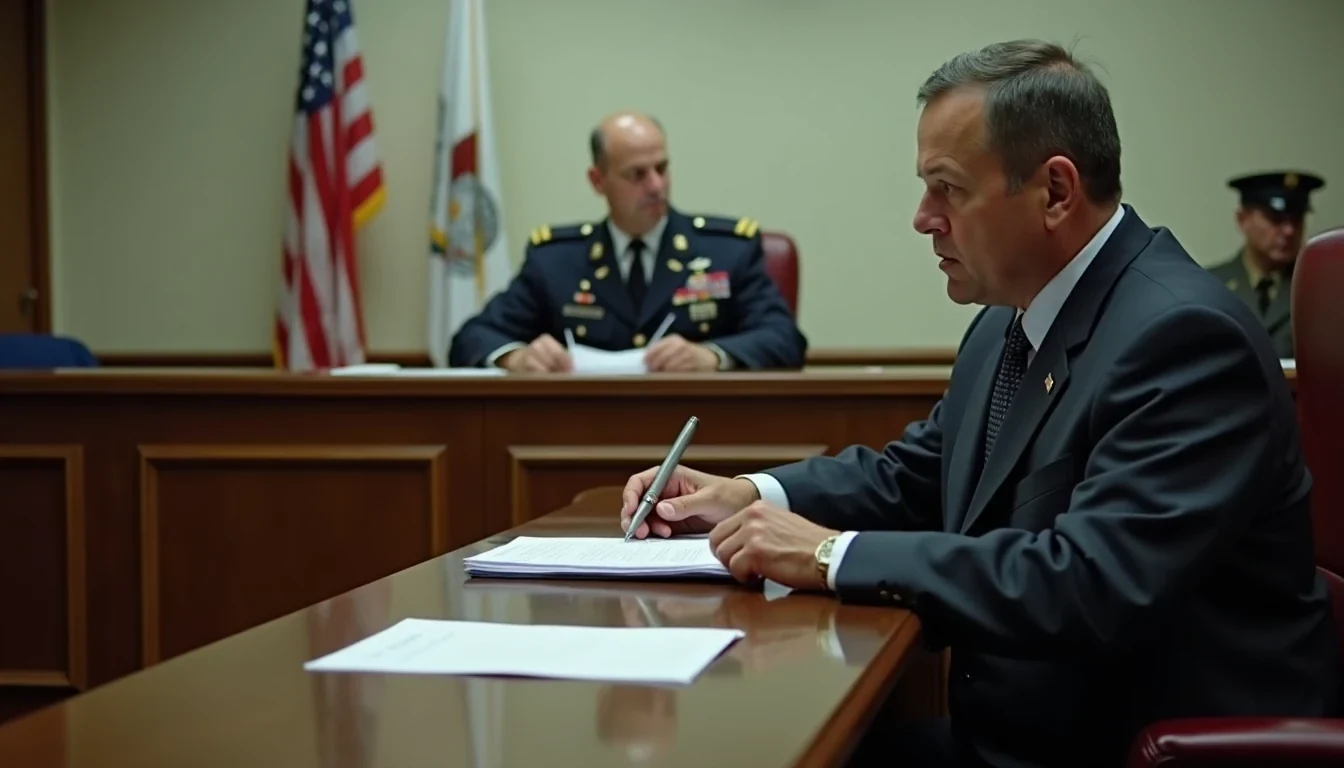
Twenty-seven years after hijacked planes tore into the World Trade Center and the Pentagon, the man accused of orchestrating the attack still has no trial date. Khalid Sheikh Mohammed, captured in Pakistan in 2003, will not face a military jury until June 2028 at the earliest. Military commissions judge Michael Schrama rejected the prosecution’s request for January 2027, adding another eighteen months to a legal odyssey that has already spanned four presidential administrations. The delay is the story.
Mohammed and three alleged co-conspirators, Walid bin Attash, Ali Abdul Aziz Ali, and Mustafa Ahmed al-Hawsawi, have been held at Guantánamo Bay since 2006. The U.S. did not charge Mohammed until 2008, five years after his detention began. His lawyers sought a plea agreement, offering guilty pleas in exchange for potential death sentences. That effort collapsed. What remains is a prosecution his defense team insists has been engineered to outrun its own evidence.
The torture question the government cannot escape
The 2014 Senate Intelligence Committee report documented what the CIA termed “enhanced interrogation techniques” applied to Mohammed and others. The details are specific and grim: 183 instances of waterboarding, described in the report as “a series of near-drownings,” alongside sleep deprivation stretching to 180 hours, forced stress positions, confinement in small boxes, and medically unnecessary rectal rehydration. These were systematic, repeated, and officially sanctioned at black sites operating beyond conventional oversight.
Mohammed’s defense argues that this history has made a fair trial impossible, and that the glacial pace of proceedings serves a deliberate purpose. The longer the case drags, the harder it becomes to present fresh evidence of abuse, locate witnesses, and reconstruct conditions at facilities the CIA has worked to keep hidden. The prosecution, meanwhile, maintains that sufficient evidence exists independent of torture-tainted statements, and that military commissions offer the only viable forum for handling classified material without compromising national security.
Both claims deserve scrutiny. The prosecution’s argument assumes a parallel legal system, constructed after 9/11 and repeatedly revised by Congress and the Supreme Court, can deliver legitimacy that federal courts could not. The defense’s counter assumes legitimacy was forfeited the moment interrogators strapped Mohammed to a waterboard for the first time. Neither assumption resolves the other. They coexist in stalemate, and the stalemate has become the operating system of American justice for terrorism suspects.
Guantánamo’s legal fiction and its consequences
The facility’s location on Cuban soil has enabled its most controversial feature: the Justice Department’s position that habeas corpus does not apply there because Guantánamo is not technically U.S. territory. This interpretation, advanced to permit indefinite detention without charge, created a legal grey area that the Supreme Court has partially narrowed but never fully closed. The 2004 Rasul decision and the 2008 Boumediene ruling affirmed some detainee rights to challenge imprisonment, yet the underlying framework, military commissions with rules distinct from federal courts, persists.
Minimal oversight at black sites and Guantánamo itself allowed interrogation practices that now contaminate the prosecution’s evidence pool. The “fruit of the poisonous tree” doctrine, excluding evidence derived from illegal methods, has consumed years of pre-trial litigation without producing clarity. Judges have rotated in and out. Defense teams have turned over. Legal precedents have shifted mid-proceeding. Each disruption forces new personnel to master a record now measured in thousands of pages, and each mastery is temporary.
The result is structural drift, a system designed to operate outside normal constitutional constraints discovering that those constraints existed for reasons. Speedy trial guarantees, transparent evidence rules, and habeas review developed over centuries not as obstacles to justice but as its prerequisites. Their suspension was supposed to be temporary, an emergency measure for an emergency moment. The emergency has become permanent, and the temporary has become twenty-seven years.
What the delay reveals about American counter-terrorism
The Mohammed case sits at the intersection of two competing narratives about American power after 9/11. One holds that extraordinary threats justified extraordinary methods, and that military commissions represent a pragmatic adaptation to an enemy that does not wear uniforms or respect borders. The other holds that the adaptation corrupted the source, that a nation cannot torture suspects, deny them habeas corpus, delay their trials by decades, and still claim to be practicing justice rather than performing it.
The international audience has already rendered its verdict. American advocacy for human rights abroad carries the weight of Guantánamo in every exchange. When U.S. diplomats press foreign governments on due process or detention conditions, the rebuttal writes itself. The damage is precedent. The framework constructed for Mohammed has normalized practices, legal arguments, and institutional habits that outlast the specific case and reshape how the state handles suspicion itself.
For the 9/11 families, the delay compounds injury with insult. For American law, a sufficiently feared defendant can be held outside the constitutional order indefinitely, with no terminal point to the exception. Mohammed will be seventy-three when the trial begins, assuming no further postponements. The witnesses who could speak to his treatment have aged, scattered, or remain classified out of reach. The evidence has been filtered through so many layers of secrecy and dispute that whatever emerges in 2028 will bear only partial resemblance to what actually occurred.
The cost of an endless pre-trial
The prosecution wants convictions. The defense wants exposure of torture. Neither has obtained its objective, and the failure is mutual. What has been constructed instead is a demonstration project in institutional paralysis, a system so determined to avoid the consequences of its own methods that it has forgotten how to reach an ending.
Judge Schrama’s 2028 date is a placeholder, vulnerable to the same churn of personnel, precedent, and procedural challenge that has consumed the previous two decades. The military commission system has proved its fragility. Federal courts have handled terrorism prosecutions before and since 9/11 with established rules, transparent records, and concluded sentences. The choice to route Mohammed through Guantánamo was political, and the politics have aged poorly.
Mohammed’s guilt or innocence is for a jury to determine, if a jury is ever empaneled. The system’s guilt is already established. It tortured a suspect, hid the torture, delayed the trial to obscure the hiding, and built a legal architecture to excuse each stage. The 2028 date extends this trajectory, another interval in a detention without apparent limit and a justice system that has learned to postpone rather than decide.
The moral cost is measured in years of life extracted without verdict, in legal principles hollowed by exception, in a nation’s claim to lawful conduct undermined by its own documented practices. When the trial finally convenes, if it convenes, the verdict on American justice will already be in. The court will merely be catching up to what the delay itself has already declared.