
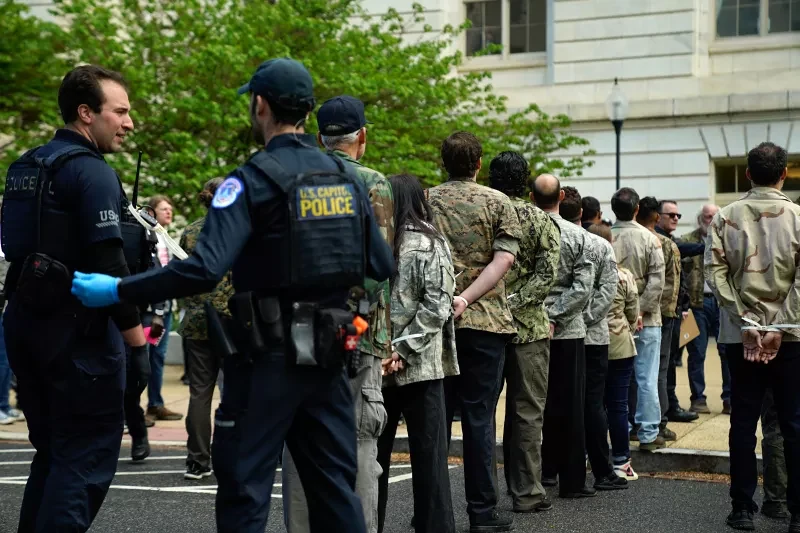
Veterans are not supposed to be the first people warning a country away from war. When they are, it usually means the political class has pushed the argument past the point where slogans still work. That is the signal coming from Capitol Hill, where former service members and military families gathered to oppose U.S. military action in Iran and to say, with uncommon bluntness, that the country is drifting into another conflict before it has honestly explained why.
The protest was not a symbolic handful of placards. More than 150 veterans and family members entered the Cannon House Office Building to demand that the war stop. Capitol Police broke up the April 20 demonstration and arrested 66 people, though About Face, one of the organizing groups, said everyone taken into custody has since been released. The images and clips spread quickly online because they tapped into a mood already growing beyond the veterans’ crowd: fatigue, suspicion, and a sense that Washington is repeating a familiar script.
Veterans Are Hearing Old Arguments
Kevin Benderman understands that script too well. When he learned the United States had gone to war with Iran, he says it dragged him back roughly two decades to Fort Hood, Texas, when he was ordered to deploy to Iraq. That experience, he says, changed him permanently. The Army veteran now lives in Augusta, Georgia, and his own military family background did not shield him from the trauma or the losses that followed.
His anger is not abstract. Benderman said he was “just nervous and upset” about what younger troops may face in Iran and what they are already facing. That fear helped send him to Washington. It also explains why this protest felt less like an activist event than a warning from people who know what war looks like once the rhetoric fades.
Benderman sees a direct line between Iraq and Iran. In 2003, he believed the case for invading Iraq because officials said Saddam Hussein had weapons of mass destruction and posed a threat. The weapons never materialized. That is why he is skeptical now when the White House says Iran is close to a nuclear weapon. He is not persuaded by familiar claims of urgency wrapped around incomplete evidence.
He was even more forceful about the moral judgment. In his view, there was no defensible reason to send Americans into Iraq and no defensible reason to do the same in Iran. After his first Iraq deployment, he refused to go again on moral grounds and was sentenced to 15 months in military prison. He says the memory of that war still follows him, especially the rituals around the dead and the anguish of families left behind. His fear is simple: that another generation of service members will be made to carry the same burden.
The Protest Was About The Human Cost
The demonstration was organized by About Face along with the Center on Conscience and War, Veterans For Peace, the Fayetteville Resistance Coalition, Military Families Speak Out, and 50501 Veterans. Under the Cannon rotunda, veterans of different ages, including some with visible disabilities, wore military jackets for a flag-folding ceremony honoring Americans killed in the conflict. They also held red tulips for Iranians who have died in airstrikes. That detail matters. It showed the protest was not narrowly nationalist. The organizers were making a moral claim about all the dead, not only the American ones.
About Face interim organizing director and Marine Corps veteran Matt Howard put the point plainly: “We cannot afford another war.” He added that paying for this one means exposing more people to danger. That is the deeper argument here. Veterans are not merely objecting to policy. They are challenging the assumption that another military campaign can be launched without fresh costs in bodies, trauma, and instability.
Robert Cheng, an Army veteran at the protest, said he fears this war will last as long as Iraq and Afghanistan did. That fear is not melodramatic; it is grounded in what Americans have already lived through. Cheng said he felt a deep frustration that yet another war had started in his lifetime. He was also disturbed by the Feb. 28 missile strike on an Iranian girls’ school, which a preliminary assessment said the U.S. was responsible for, and by the continuing blockade on Iranian ports.
His criticism went beyond battlefield tactics. Cheng said the war is not improving anything and does not amount to a solution to nuclear de-escalation. He also said the White House has been presenting the conflict online through edited clips that mix real strikes with pop music and video game imagery. His point was not merely aesthetic. It was that the administration seems to be packaging war for consumption instead of defending it as a grave national decision.
Public Disapproval Is Catching Up
The veterans may have led the protest, but they are not alone. A Reuters/Ipsos survey taken April 15-20 found that 60% of Americans disapprove of U.S. strikes against Iran. More than half, 51%, said the action was not worth the cost and the risk. Those numbers matter because they suggest the White House is fighting not just a military campaign but a credibility problem.
The administration’s answer is predictable and serious in its own terms. In response to NPR’s question about veterans’ concerns, White House spokesperson Anna Kelly said President Trump acted decisively to make sure Iran could not threaten the homeland, U.S. troops, or allies again. She argued that removing Iran’s nuclear threat would leave America and the world safer and more stable.
That is the central divide. The White House is selling deterrence and security. Veterans at the Capitol are asking for proof that the price is justified. They are looking at the casualties, the deployments, the blockade, and the growing regional damage and seeing the beginning of another long, open-ended war.
What This Means Now
The scale of the commitment is already significant. Since the war began on Feb. 28, about 50,000 American troops have been sent to the Middle East. The Defense Department says 13 service members have been killed and 400 wounded. Iran’s forensic medical agency says more than 3,300 people have died in U.S.-Israeli attacks. Those are not numbers you can spin away with a video montage or a press release.
Jessica Serrato knows the war from the family side. Her partner is deployed in the Middle East, and she said she has lived with constant worry about whether he will come home safely and what the conflict might do to him long after the fighting ends. She said he is scared too, but locked into fight-or-flight mode. Serrato is not ignorant of military life. What unsettles her is the lack of clarity. She went to Capitol Hill looking for answers she still does not have: when troops will come home, why they are there, and why more are still being sent.
That is the real political danger for the White House. Once veterans, military families, and a majority of the public start asking the same questions, the war is no longer just a foreign policy operation. It becomes a test of whether the government can still explain its own use of force in language that survives contact with reality. Origional Story